The James Webb Space Telescope has discovered "planets" the size of Jupiter that move freely in space and are not gravitationally bound to any star. Scientists were especially surprised that these objects apparently move in pairs. According to one version, the planets formed in that part of the Orion nebula, where the density of matter was insufficient for the formation of full-fledged stars. And if you imagine that girls live on one planet, and boys live on another, and all this happens in the dark (because there is no Sun nearby).. Cybernetics engineers begin to...
Continue reading Browsing category:
News

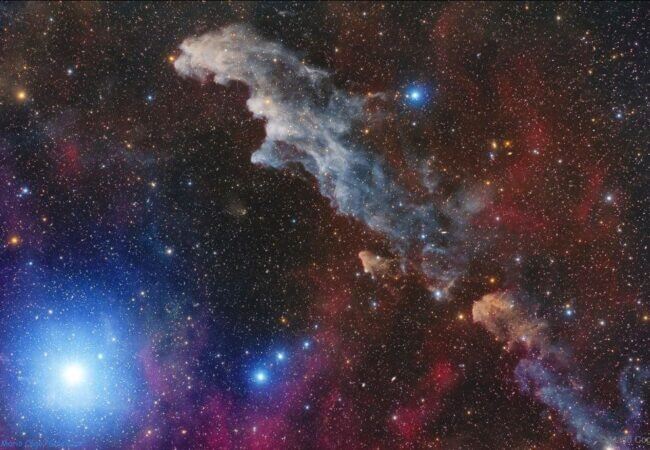
Continuing the theme of winds, ships and the lively twinkling of the Universe - I want to show you - the Witch's Head Nebula (IC 2118) - a reflection nebula in the constellation Eridanus, which is located at a distance of about 900 light years from us. In this image, the witch's face looks up at the bright star Rigel (Beta Orion [β]) just beyond. It took 11 hours and 40 minutes to collect light from these stars in a telescope to capture this image of deep space. And now, closing your eyes, begin to breathe more slowly, and imagine yourself as this world traveling...
Continue reading
Today there are shellings in Kharkiv, and the weather is getting more and more like October. However, there are places in our solar system with much harsher conditions of existence. Venus seems like the last place you would look for life. It has a very high temperature; a thick, foggy atmosphere shedding drops of sulfuric acid. Venus is often compared to the embodiment of hell, a landscape of fire and brimstone. However, scientists suggest that liquid droplets in the upper clouds of Venus could potentially form a place where microbial life forms thrive. Rocket...
Continue reading
A little about the eternal, ships and winds... You can imagine a scale model of the solar system in your room. At this scale, Jupiter would be 5 cm from the Sun. Keep moving, say, to the right and imagine the relative distances. Saturn would be 10 cm from the Sun, Uranus would be 19 cm from the Sun, and Neptune would be 30 cm from the Sun. Little old Pluto is usually about 40 cm from the Sun. However, on this scale, the physical diameter of the solar system is much larger. The outer edge of the Oort Cloud, a vast shell made up of perhaps a trillion comets, would...
Continue reading
The OSIRIS-REx mission launched from Cape Canaveral on September 8, 2016 in the direction of asteroid Bennu. On December 3, 2018, the probe reached Bennu, revealing that the dark asteroid is a primordial, rock-covered world, about 500 m in diameter. On September 24, the spacecraft's primary mission ended when it flew past Earth and dropped the largest set of samples ever returned from an asteroid. The intact rocks will become a scientific treasure, a window into the early solar system that may provide clues to the origin of water and life on Earth. Despite the...
Continue reading
Astronomers have discovered that the closest black holes to Earth may exist in the Hyades star cluster. Observations from the Gaia satellite suggest that this nearby group of stars may have several black holes.
Continue reading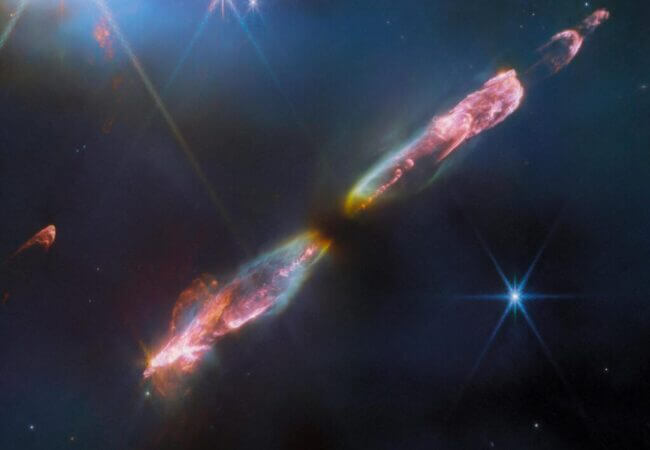
New images taken by the James Webb Space Telescope (JWST) show these powerful jets of stellar matter flaring up and flying in all directions from the poles of the young star. This cosmic phenomenon unfolds in the constellation Perseus, at a distance of approximately 1,000 light years from Earth. The jets fly out in opposite directions from the young luminary. The protostar, whose weight is only 8% of our Sun, resembles it in the past, when it was several tens of thousands of years ago. Astronomers believe that over time it will turn into a star similar to the...
Continue reading
Comet C/2022 E3 is already 1 magnitude ahead of its brightness schedule. Most likely, at the end of January, it will be similar to Neowise (the most favorite Comet in the last 10 years). I hope that the cosmos reminds us in this way - it is too early to relax, but the victory will be ours! By the way, all Arta with the past holiday. Who wants to support the #astrokhata project - 5363542309185149 www.astrohata.com Telegram - https://t.me/astrohatacom Instagram - https://www.instagram.com/astrohata/...
Continue reading
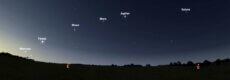
#Astrochate is still under occupation, but some things cannot be missed. On June 24, from 2-00 to 4-00 at night, the alignment (parade) of five planets will take place: Mercury, Venus, Mars, Jupiter and Saturn. This astronomical event can be seen with the naked eye. The waning moon will be in line with the planets - between Venus and Mars. You have to look to the east, one hand a bottle of wine in the other a loved one (unless, of course, you do not have as much bombing as in Kharkov). The war will end someday, but astronomy is forever). Who wants to support the...
Continue reading
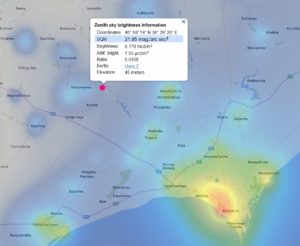
Friends, you often ask us what to do at AstroHata. Yes, #Astrokhata is a night resort, for astronomy, and our main life begins at 20-00 What to do in the morning and afternoon. And here are 10 pearls of the Azov region according to Astrokhata -
Continue reading